
You finally get everyone into pyjamas, pour yourself a tea, and just as calm begins to settle and you are ready to wind down for the evening— you find a little face still glowing blue in the dark. “Just one more episode?” they plead.
You sigh, torn between needing a break and wanting them to rest.
You’re not alone.
As the evenings draw in and routines shift, screens often sneak into our family wind-down time. Tablets become bedtime companions, story apps replace books, and glowing pixels outshine lamplight. But when screens steal sleep, they quietly steal calm too.
This post is here to help you reclaim bedtime — gently. We’ll explore why screens make sleep harder, simple swaps that soothe rather than stimulate, and easy rituals that help children’s bodies remember how to rest.
Why It Matters
Modern family life is threaded with technology — it helps us connect, learn, and unwind. But for young children, the boundary between stimulation and rest is still developing.
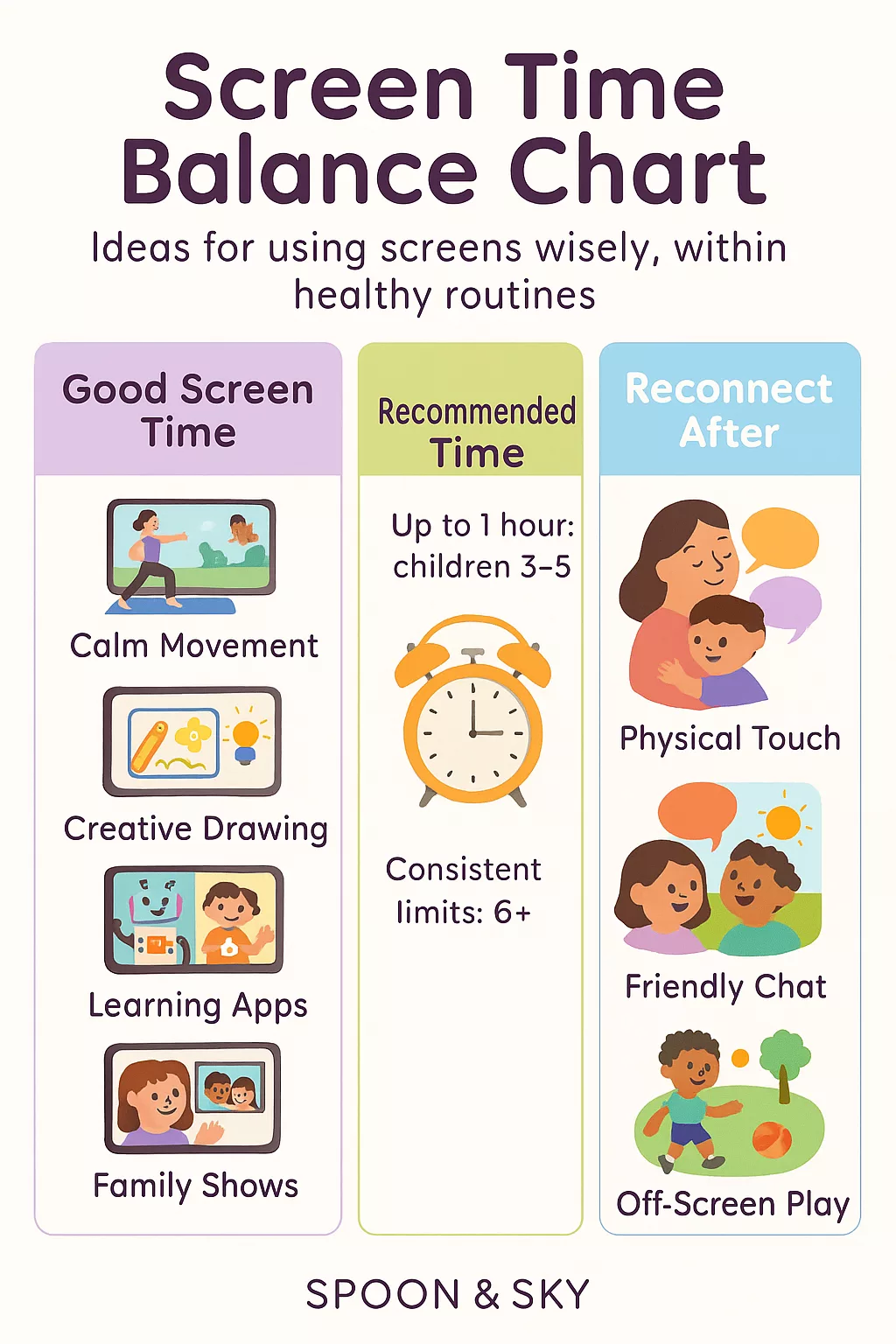
Blue light from screens suppresses melatonin, the body’s natural “sleep hormone.” It tricks the brain into thinking it’s still daytime, delaying sleep and making it harder to drift off. The American Academy of Pediatrics recommends that screens be turned off at least one hour before bedtime, but many families find this difficult — especially when screens are woven into evening routines.
Sleep isn’t just rest; it’s repair. Children’s brains consolidate memory, regulate emotions, and restore energy while they sleep. When sleep is disrupted, we often see more meltdowns, fidgeting, and emotional volatility the next day.
Understanding the “why” helps us create realistic routines rather than rigid rules. The goal isn’t to banish screens forever — it’s to restore rhythm, calm, and connection as the day softens toward night.
The Practical Framework 🌿
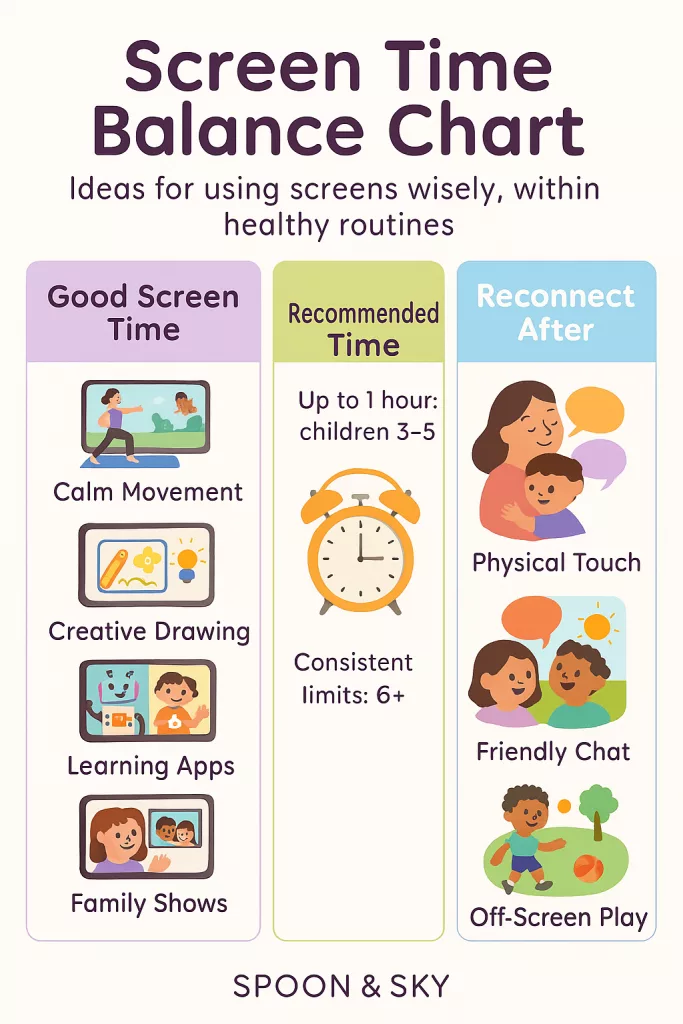
Here are seven calm, practical ideas for families to make evenings softer — and sleep deeper.
💡 1. Create a “Screen Sunset”
Choose a daily time when devices go to rest — ideally 60–90 minutes before your child’s bedtime. Present it as a ritual, not a rule.
🪄 Try this:
Set a gentle reminder sound (like a bird song or chime) to signal the start of “screen sunset.” Everyone (yes, adults too) dims lights, puts devices on charge, and shifts toward slower activities.
Parent tip: Keep the timing consistent. Children’s bodies love predictability — it signals safety.
🌙 2. Replace Glow with Glow — But the Natural Kind
Swap blue-light screens for warm-light rituals: lamps, night-lights, or fairy lights.
Encourage your child to help choose a special “bedtime glow” corner — a reading nook, soft blanket, and a small lamp.
🪄 Try this:
Introduce “Sparkle Time” — five minutes where you turn off the main light and let the room glow gently while soft music or an audio story plays.
📚 3. Story Time Still Matters (Even in the Digital Age)
Research shows that shared reading lowers heart rate and stress for both parent and child. It’s a sensory signal of safety and togetherness.
🪄 Try this:
Alternate between printed books and audio stories or podcasts. Look for calm narratives with gentle pacing (not cliffhangers!).
Some families use “book baskets” — a rotating selection of bedtime-only books that stay beside the bed.
Parent tip: If you use a tablet for stories, enable night mode, dim brightness, and switch to audio-only playback once the child is tucked in.
🧘 4. Build a Sensory Wind-Down Routine
Children’s bodies respond beautifully to multi-sensory cues. Choose 2–3 soothing sensations each night:
| Sense | Calming Cue | Ideas |
|---|---|---|
| Touch | Warmth | A cozy blanket, a warm water bottle, or gentle back rub |
| Smell | Comfort | A dab of lavender lotion, or a familiar scent (fresh pajamas) |
| Sound | Softness | White noise, lullabies, or a gentle audiobook |
| Sight | Dimness | Warm lamplight, fairy lights, or stars on the ceiling |
🪄 Try this:
Name your sequence aloud: “First we brush teeth, then cozy lotion, then sparkle time.” The repetition itself becomes a comfort signal.
🕊 5. Handle Night-Wakings with Connection, Not Frustration
Even with good routines, many children wake in the night. Screens make it harder to return to sleep because they re-stimulate the brain.
🪄 Try this:
Keep lights low. Avoid bright bathroom or hallway lights — use a warm nightlight instead. Speak in whispers. Offer reassurance, not entertainment:
“It’s still nighttime, your bed is waiting, and so am I.”
Parent tip: A calm return to bed teaches children that night-wakings aren’t emergencies, just gentle pauses.
✨ 6. Involve Kids in Creating Calm
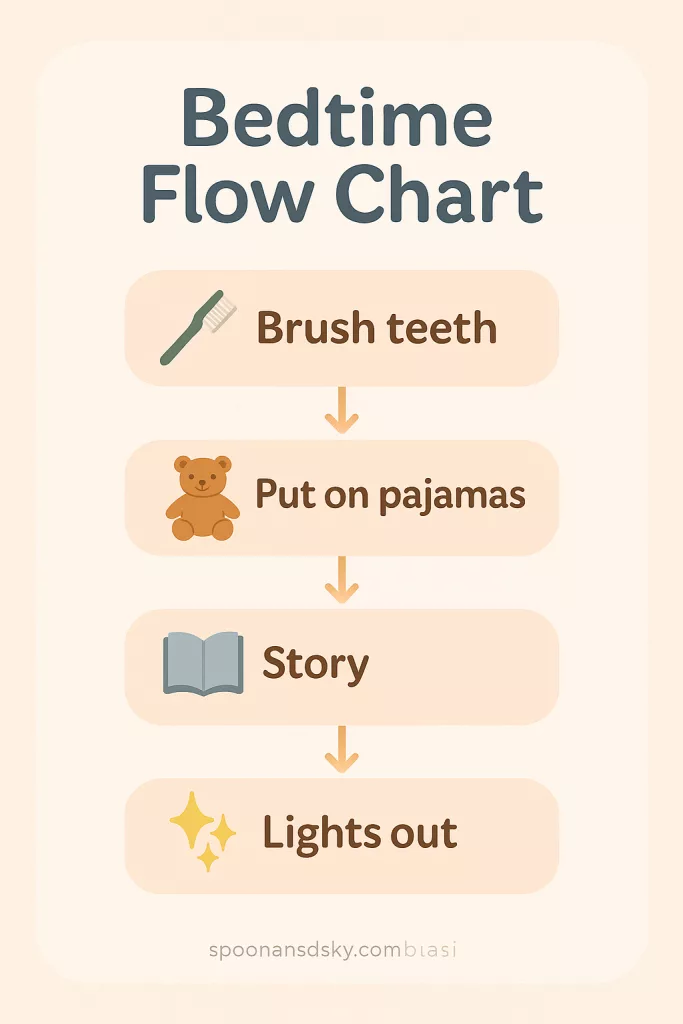
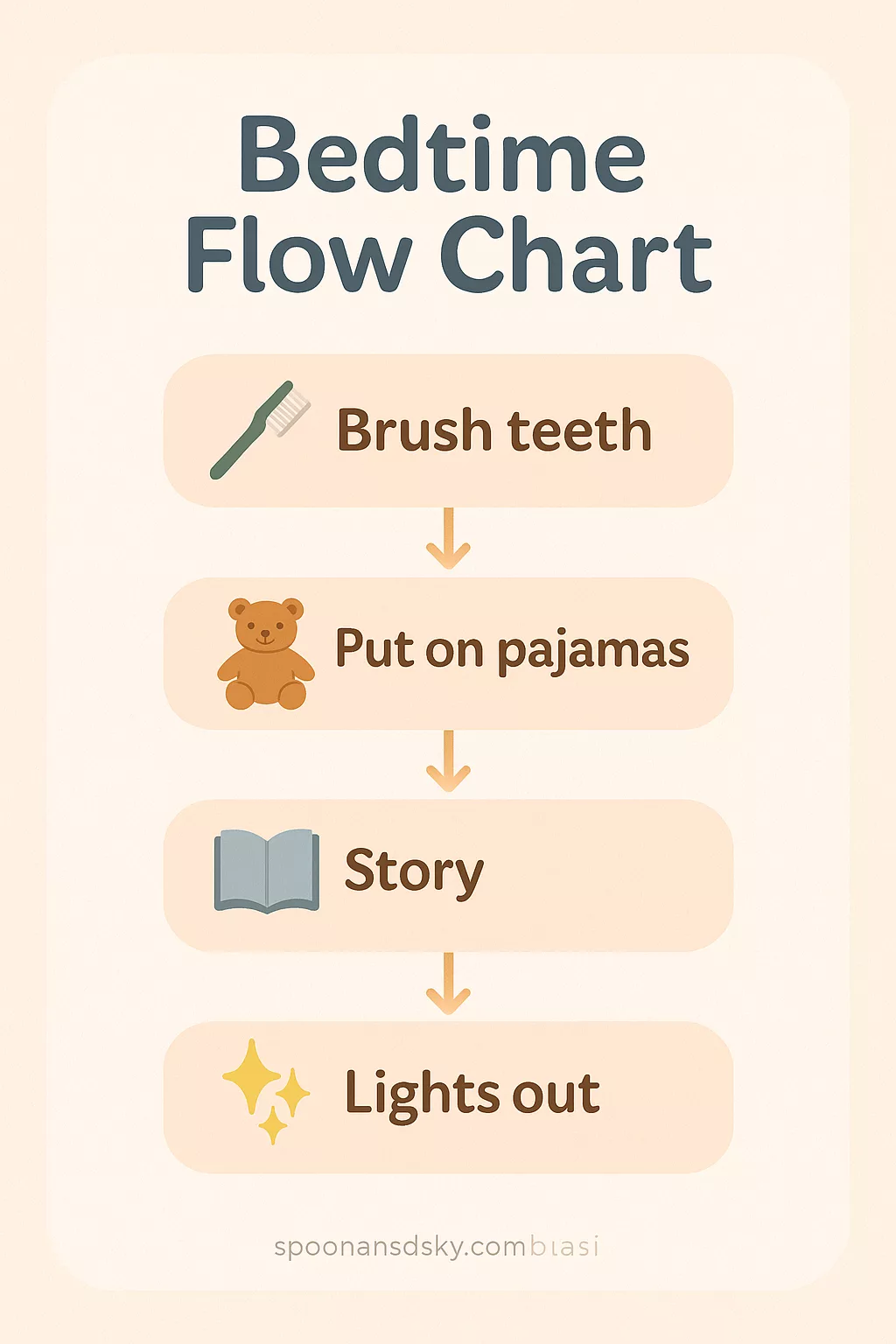
Children are more likely to follow a plan they help design. Let them help build their own Bedtime Flow Chart — draw or print simple steps:
🪥 Brush teeth → 🧸 Put on pyjamas → 📚 Story → ✨ Lights out
🪄 Try this:
Use stickers or magnets to mark each completed step. This gives children agency while reinforcing the structure.
🐻 7. Keep Comfort Objects Close
Stuffed animals, cozy blankets, and familiar scents all help children self-soothe. Encourage your child to “tuck in” their toy at bedtime — it models gentleness and care.
Parent tip: A “sleep buddy” helps transition comfort from parent to child — especially in families working toward independent sleep.
🌾 Reconnecting After the Glow
One of the most healing shifts you can make isn’t about banning screens — it’s about what comes after them. When we simply turn devices off and rush straight to bed, children’s minds can feel stranded mid-story, mid-adventure, mid-scroll. They need a bridge — a small moment to reconnect with real life, to “land” in their bodies and in your presence again.
That bridge doesn’t have to be long or elaborate, check out some ideas on this blog post for 7 quick connection moments throughout the week for busy parents. It might be a five-minute cuddle under a blanket, a whispered chat about the best part of the day, or a simple breathing game: “Let’s blow out three sleepy candles together.” These gentle cues help your child’s nervous system shift from stimulation to safety — from alert to anchored.
It can also help to invite your child to notice how they feel after screens versus after quiet play. Ask: “Does your body feel buzzy or sleepy right now?” Helping them tune into their own sensations teaches lifelong awareness — the foundation of self-regulation.
Some families create a “wind-down box” filled with small, screen-free treasures: colouring pages, magnetic puzzles, soft brushes for sensory play, or a favourite bedtime book. It’s there as an easy grab-bag when screens go off and calm needs to begin.
This transition time matters as much as the sleep that follows. It tells children that rest isn’t a punishment for fun — it’s the natural next step in a rhythm that holds them, night after night. With every quiet laugh, slow breath, and dim light, you’re teaching your child something precious: that calm isn’t the absence of stimulation, but the presence of connection.
Reflection

When screens fade and quiet returns, something almost magical happens — your child rediscovers their own rhythm. Their breathing slows. Imagination stirs. Connection returns.
Bedtime isn’t a battle to win; it’s a relationship to tend. Some nights will still unravel — that’s okay. The measure of success isn’t perfect calm, but consistent care. Every time you dim the lights, put your phone aside, or pause for a story, you’re teaching your child the language of rest.
🪄 Download our printable “Bedtime Flow Chart” — a gentle visual routine for calmer nights, get it below:
Screens will always be part of modern childhood — but they don’t have to steal our nights. With rhythm, ritual, and softness, bedtime can once again be what it’s meant to be: a safe return to stillness, story, and sleep.
💤 With a cup of chamomile and a softly humming night-light,
Lily Luz – Spoon & Sky Studios


✨ Get Your Free Printable ✨
Looking for a simple way to bring a little more calm, structure, or creativity into your day?
Enter your email below and get instant access to your free printable from Spoon & Sky — made to spark joy, imagination, and gentle rhythms at home. 🌿
We’ll send your printable and a few kind, helpful ideas to your inbox. No spam — just calm, creative family tools.
Leave a Reply