
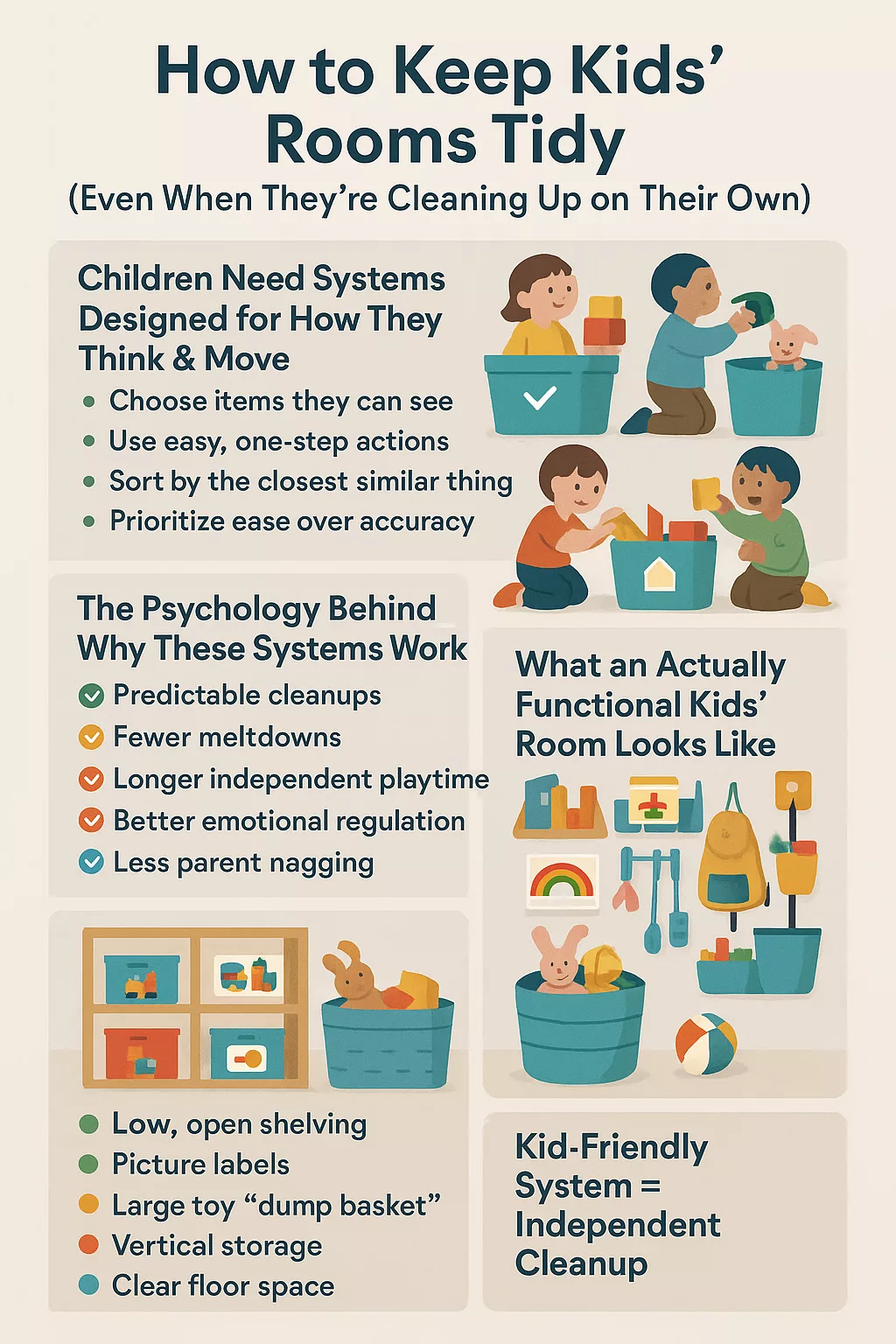
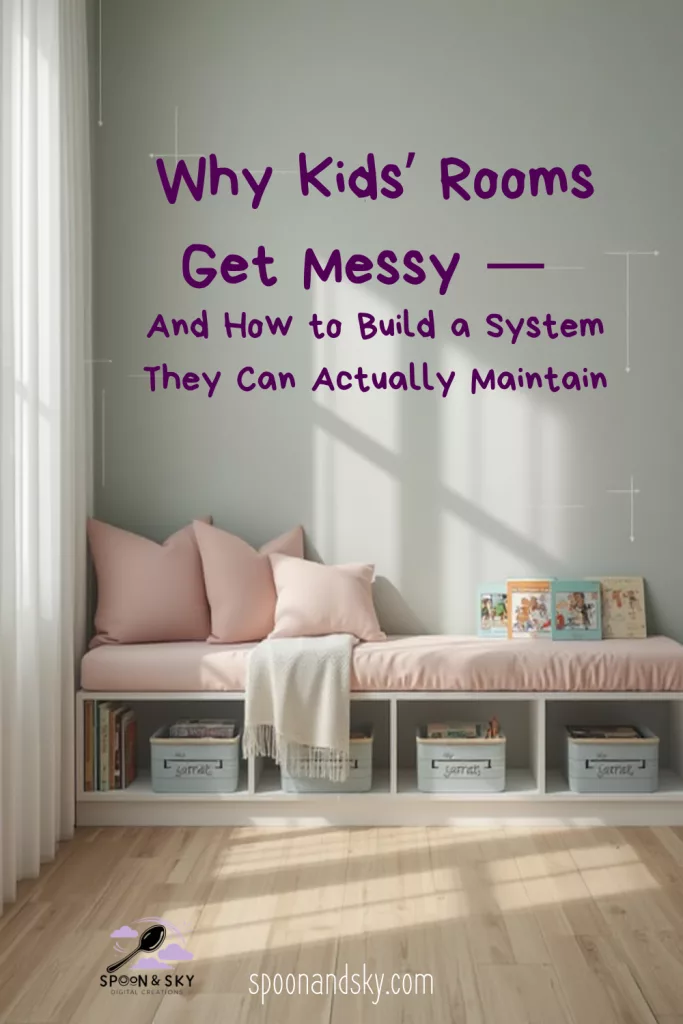
A child-friendly organization system is the missing link in most kids’ rooms, and it’s the reason even well-intentioned tidy routines fall apart. Children ages 3–8 don’t think, sort, or move through space the way adults do, which means adult-style storage — lidded bins, high shelves, deep toy boxes, and hidden baskets — instantly sets them up to fail. Kids need simple, visible, accessible systems that match their developmental stage and the way their brains process categories, movement, and attention. When the organization system is designed for them, not us, tidying becomes easier, independence grows, and their room transforms from overwhelming to calm and functional.
If you’ve ever walked into your child’s room and felt your heart rate go up — toys in corners, clothes on the floor, half-finished crafts on the bed, tiny objects multiplying like glitter — you’re not alone. Parents everywhere are quietly asking the same question:
“Why can’t my child keep their room tidy?”
Here’s the surprising truth:
**It’s not because they’re messy.
It’s because their room is organized for adults — not for them.**
Over-complicated systems are the #1 reason kids’ rooms fall apart. We build beautiful storage setups with adult logic: matching bins, towering shelves, deep toy boxes, hidden baskets, and neatly labelled containers that are meant to keep things “minimal.”
But for children — especially ages 3–8 — these systems are simply too hard to use.
And when a system is too complicated, inaccessible, or visually unclear, the system breaks down instantly.
This post will walk you through why this happens, how to fix it, and how to create a simple organizational structure that your child can maintain with confidence, ease, and independence.
Because the goal isn’t perfection.
The goal is function your child can truly maintain.
Why Most Kids’ Rooms Fail (It’s Not the Mess — It’s the System)
Take a moment to picture a typical adult-organized kids’ room:
- Lidded storage boxes
- High shelves
- Deep toy baskets
- Matching fabric bins
- Closed cupboards
- Drawers stuffed with mixed items
- Pretty systems that need adult-level fine motor skills
To us, these look clean.
To a 5-year-old, they look confusing — or totally unreachable.
Kids live low to the ground. They use their whole body to explore. Their decision-making is quick and impulsive. Their sense of category sorting is still developing. Their arms are short. Their legs are shorter.
So when we set up systems meant to hide clutter or streamline aesthetics, we accidentally create barriers:
❌ Systems kids can’t reach
❌ Systems kids can’t see into
❌ Systems kids can’t easily open
❌ Systems kids can’t remember
❌ Systems kids can’t repeat
And when a child can’t fully close the loop, the whole structure collapses.
It’s not disobedience.
It’s design.
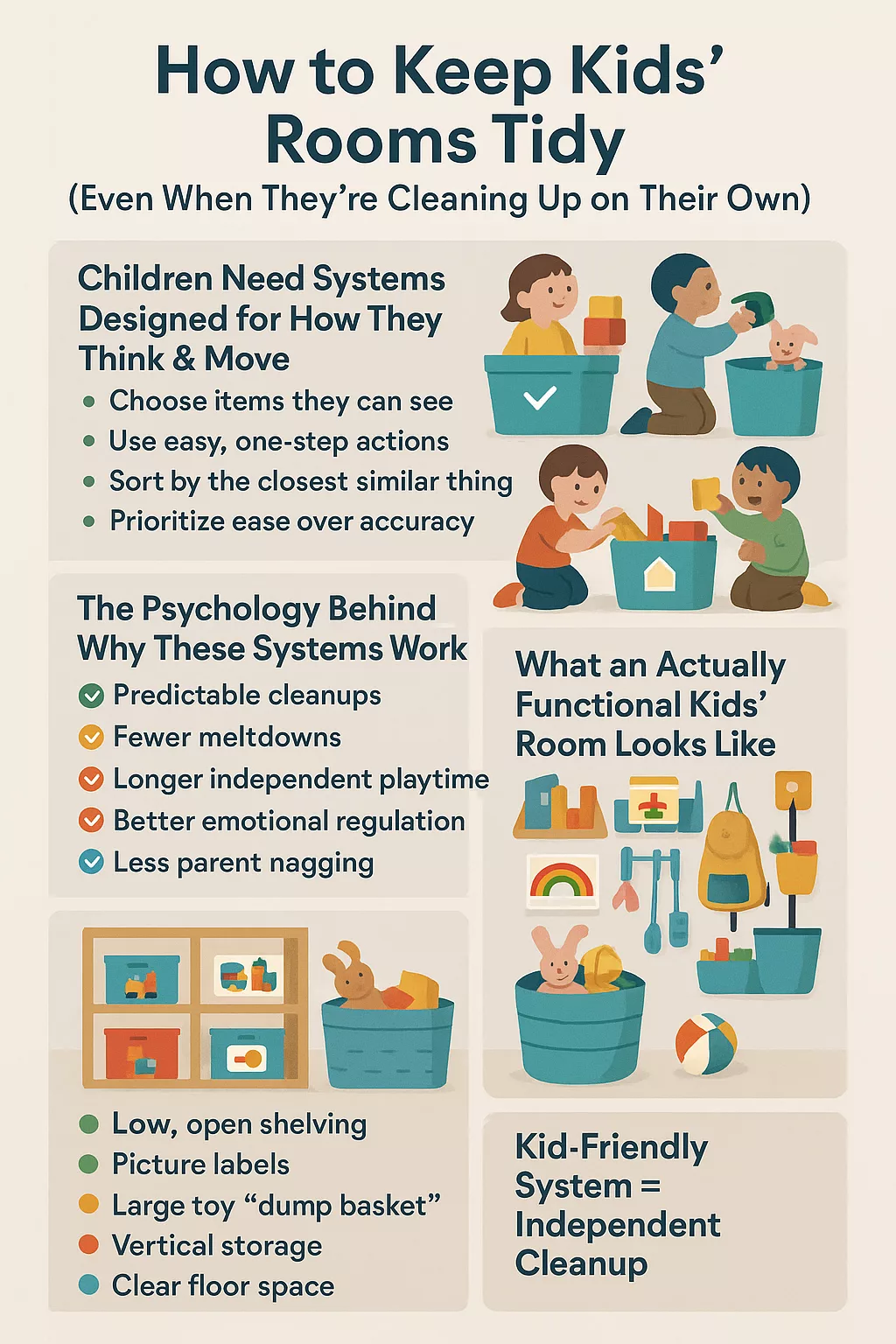
Children Need Systems Designed for How They Think and Move
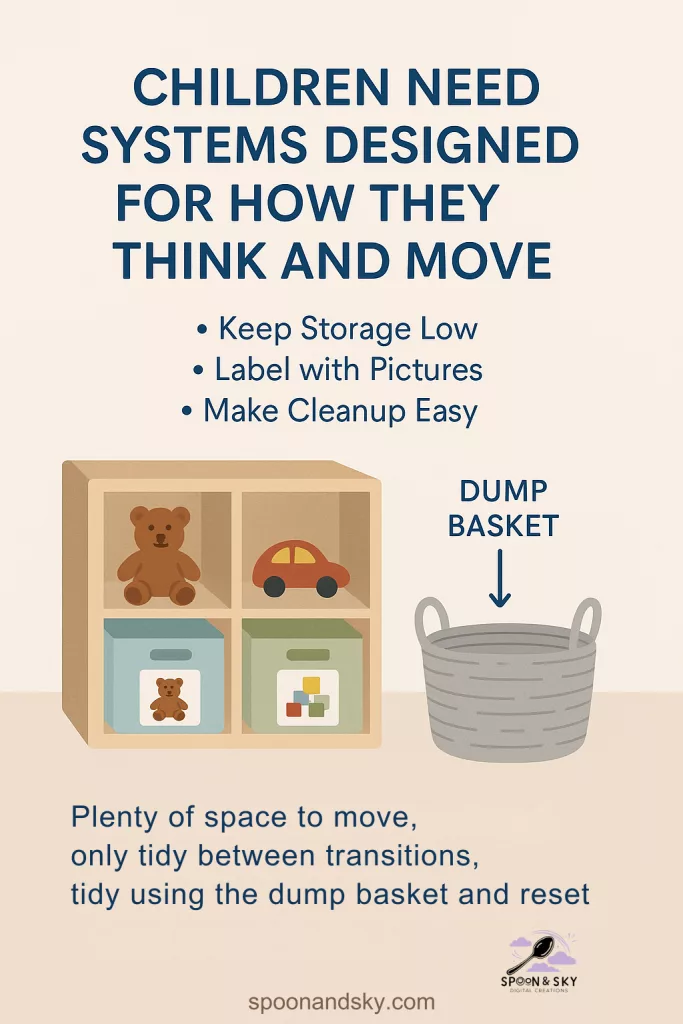
Kids don’t organize like adults. They don’t tidy like adults. And they don’t cognitively break down categories like adults.
Here’s how children actually behave:
✅ They choose items based on visibility
If they can’t see it, it doesn’t exist.
If they can see everything at once, it becomes chaos.
✅ They put things away based on the “closest similar thing”
This is why all dolls end up with the stuffed animals.
And why crayons end up with LEGO.
Their sorting logic is association-based, not category-based.
✅ They need one-step actions
Anything that requires a sequence — open lid + pull bin + lift basket + find category — is too much.
✅ They prioritize ease over accuracy
If a solution isn’t obvious, the floor wins.
Knowing this allows us to design simple, child-led systems that actually work.
The Three Golden Rules of Child-Friendly Organization
Every effective kids’ room is built on these three principles:
1. If it takes more than one step, it won’t work.
Adults love lids because they look clean.
Kids hate lids because they’re annoying.
Lifts, clasps, drawers, and heavy covers create friction — and friction is the enemy of functional tidying.
Replace lidded bins with open baskets.
Replace drawers with open shelves.
One-step access is the secret.
2. If they can’t see it, they won’t use it.
Deep toy chests are black holes.
Opaque baskets are mysteries.
Stacked boxes hide toys at the bottom.
When kids can see what they have, they play more intentionally and tidy more easily.
Aim for:
- Shallow bins
- Open shelving
- Picture labels
- Forward-facing book ledges
- Clear or semi-clear organizers
Visibility builds confidence.
3. If they can’t reach it, they can’t return it.
This one sounds obvious, but it’s the most overlooked.
If a shelf is even slightly out of reach, kids will yank the next available thing down — or skip the system altogether.
A functional kids’ room system puts:
- Daily use items at waist height
- Often used items at knee-to-shoulder height
- Rarely used items above adult shoulders
- Special items stored safely up high
Child height = child independence.
The Psychology Behind Why These Systems Work
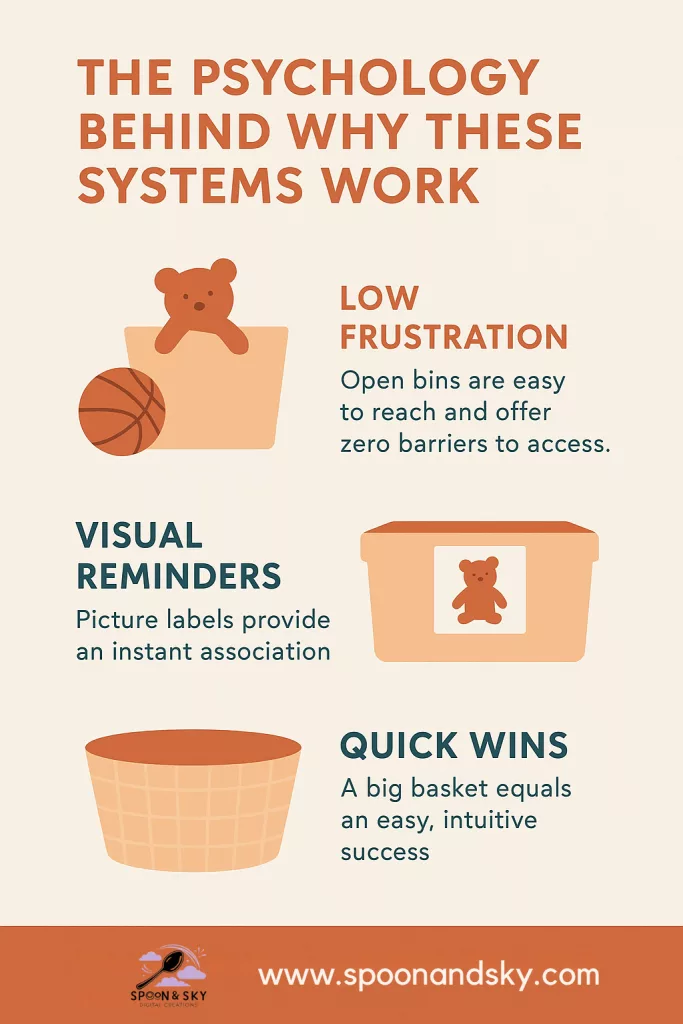
When the room is structured for children — not adults — everything changes:
✅ Cleanup becomes predictable
Children understand where things go without reminders.
✅ Fewer meltdowns
An uncluttered floor equals a calmer nervous system.
✅ Longer independent play
Clear spaces invite focused play naturally.
✅ Better emotional regulation
Kids feel more capable and in control.
✅ Less nagging
You don’t have to micro-manage every tidy-up session.
✅ Stronger skills
Kids learn sequencing, categorization, and autonomy.
This isn’t just about tidying — it’s about developmental alignment.
Let’s Break Down the Most Common Adult Mistakes
These are the top organization pitfalls most parents fall into (through no fault of their own — the Pinterest influence is strong):
❌ Mistake 1: Matching fabric bins with no visibility
Fix:
Use clear bins, picture labels, or open baskets.
❌ Mistake 2: High shelves for “pretty things”
Fix:
Reserve top shelves for adult-only items: keepsakes, out-of-season clothes, rotation stock.
❌ Mistake 3: Deep toy chests
Fix:
Replace with compartmentalized cube storage or shallow bins.
❌ Mistake 4: More bins than needed
Fix:
Fewer categories = easier cleanup.
❌ Mistake 5: No dedicated zones
Fix:
Art → one spot
Books → one spot
Blocks → one spot
Stuffies → one spot
Zones create clarity.
What an Actually Functional Kids’ Room Looks Like
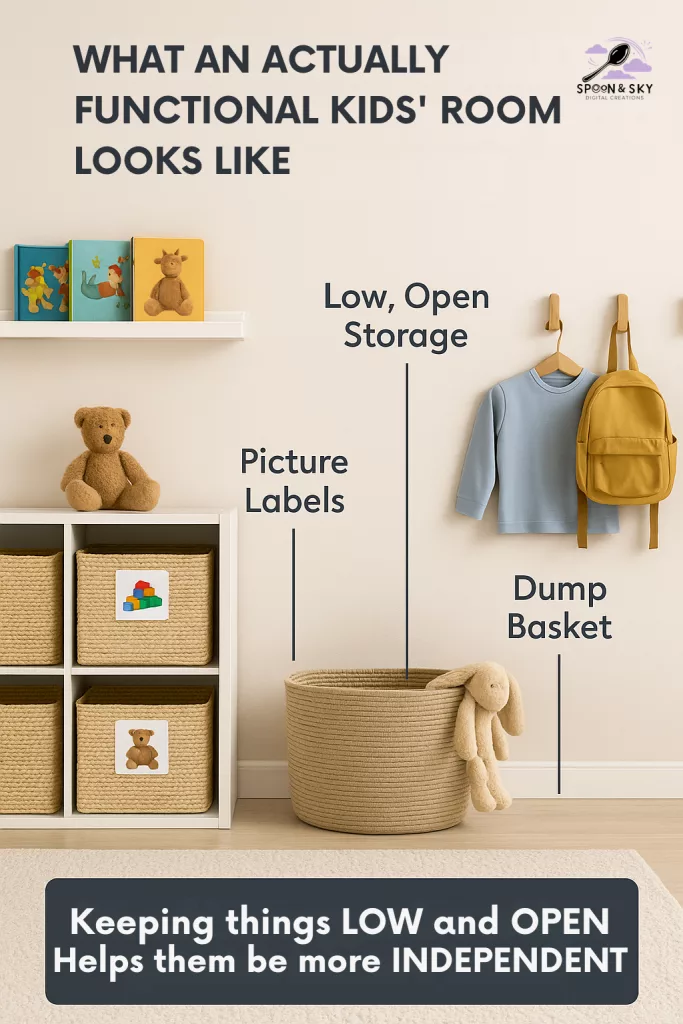
Let’s visualize it:
✅ Low, open shelving
For daily-use toys and books.
✅ Picture labels
A quick visual cue for where things go.
✅ A large, central “dump basket”
For fast cleanup when energy is low.
✅ Vertical storage
Hooks, rails, wall-mounted bins — up the walls!
✅ Under-bed storage for rotation toys
Out of sight, but easy to swap.
✅ Floor space that stays clear
This is where play expands.
When the room supports the child, the child can support the system.
A Simple Tidy Routine Kids Can Actually Follow
Here’s what a child-friendly cleanup ritual looks like:
- Dump basket first
Everything off the floor into the central bin. - Sort just a few categories
Books in shelf
Squares in blocks bin
Animals in animal basket - Reset the room visually
Teddy on bed
Book on shelf
Lamp switched on
Soft ending
This takes minutes — not battles.
Why This Matters (More Than You Think)
A child’s room isn’t just a room.
It’s their first little world.
A place where they learn:
- How to care for their belongings
- How to feel safe and capable
- How to transition between activities
- How to build focus
- How to support themselves emotionally
- How to feel ownership over their space
When the room is functional, the child is empowered.
And when the child is empowered, everything gets easier.
This is how we turn overwhelming spaces into supportive ones.
This is how we turn chaos into calm.
This is how we turn “clean your room!” from a battle cry into a natural rhythm.
Final Thoughts — and a Big Breath of Relief
You are not failing because the room is messy.
The system is failing because it wasn’t built for a child.
But the moment you shift from aesthetic-driven organization to developmentally friendly systems, everything snaps into place.
Kids thrive on simplicity.
Kids thrive on visibility.
Kids thrive on accessibility.
Kids thrive when the room is designed for their size, their logic, their developing brain.
You don’t need more space.
You just need systems that make sense to your child.
Get your guide below:
And that is a beautifully hopeful place to begin. If you want to learn more about organizing your play areas have a look at this blog post.
With warmth and a deep breath of “you’re doing better than you think,”
I’m Lily Luz — artist, mum of two, and creator of Spoon & Sky Studios.
I believe childhood runs smoother when our homes work with us, not against us. Through simple tools, gentle structure, and calm routines, we can build spaces that support imagination, independence, and joy — even on the busiest days and in the smallest rooms.
Here’s to calmer corners, easier rhythms, and homes that feel like a soft place to land.
Simple tools for joyful structure — always.
Written with structure and smiles,
Lily Luz — Spoon & Sky Studios


✨ Get Your Free Printable ✨
Looking for a simple way to bring a little more calm, structure, or creativity into your day?
Enter your email below and get instant access to your free printable from Spoon & Sky — made to spark joy, imagination, and gentle rhythms at home. 🌿
We’ll send your printable and a few kind, helpful ideas to your inbox. No spam — just calm, creative family tools.
Leave a Reply